
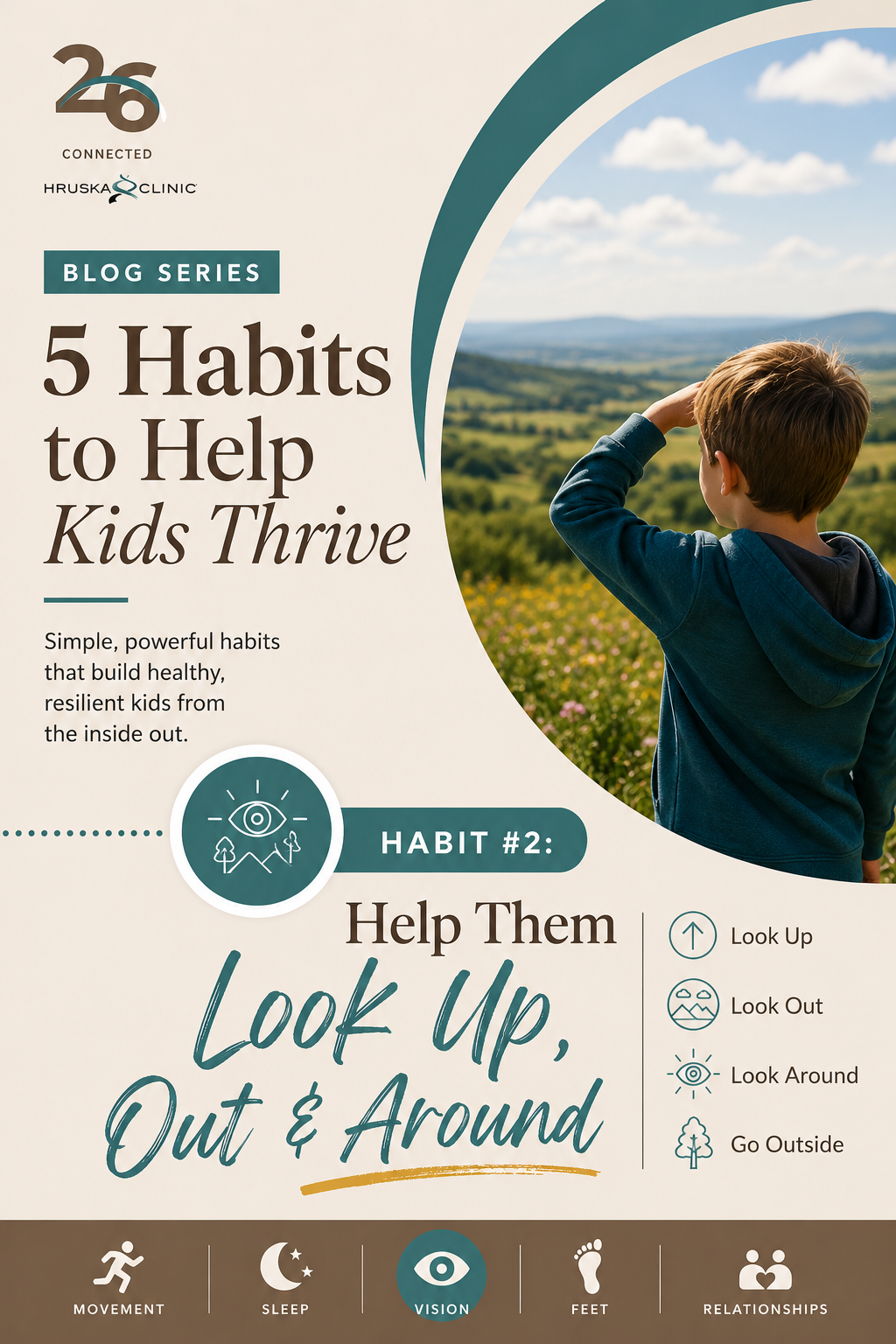
Habit #2: Help Them Look Up, Out & Around
Kids today are growing up in a world that asks their eyes to do a lot.
Phones. Tablets. Computers. Homework. Reading. Gaming. Screens at school and at home.
Screens aren’t inherently bad, and they aren’t the only factor in the development of myopia (nearsightedness). But children’s visual systems are spending more time in sustained near focus than in the varied, dynamic visual world they experience when playing, exploring, and moving outdoors.
One simple habit we can encourage is to help them look up, out, and around.
Our eyes need variety, too
When a child spends a long stretch reading or using a screen, their eyes are focused up close, often in a small, fixed area.
Now compare that with being outside.
A child might scan across a yard, notice a bird in the distance, catch movement in their peripheral vision, glance down at the sidewalk, turn toward a friend, and look across a playground—all within seconds.
Their visual world is constantly shifting.
Close. Far. Moving. Still. Up. Down. Around.
That variety gives the visual system different kinds of input and movement.
We don’t need to remove close work or screen time. Reading, schoolwork, gaming, and technology are part of modern childhood. Instead, we can build in moments throughout the day where the eyes are doing something different.
Look up. Look out. Look around.
The familiar 20-20-20 habit can help: after about 20 minutes of near work, encourage your child to look at something farther away than 20 feet for about 20 seconds.
But the numbers aren’t the main point.
The real habit is simply to change the visual environment.
Look up from the book.
Look out the window.
Look across the room.
Look down the hallway.
Look around the playground.
And whenever possible, go outside.
Outdoor time offers a richer visual experience—greater distances, more movement, and constant shifts in focus and direction.
Pay attention to what your child is telling you
Children don’t always recognize when their vision is changing. They may adapt without realizing anything is different.
Watch for signs such as:
- Squinting or sitting very close to screens
- Complaints of headaches or tired eyes
- Losing their place while reading
- Avoiding reading or other visually demanding tasks they once enjoyed
A routine eye exam can detect changes in vision even when a child doesn’t notice them.
And healthy vision is about more than seeing 20/20. Regular eye exams allow eye-care professionals to monitor eye development and identify myopia or other concerns early.
It doesn’t have to be complicated
Helping kids thrive isn’t about eliminating screens or building a perfect schedule.
It’s about balance and variety.
Let them read. Let them do homework. Let them use technology.
But also give them chances to look up, look out, go outside, and engage with the world around them.
A simple reminder can go a long way:
When they’ve been looking close for a while, encourage them to look up.
Look out.
Look around.
Small, repeated habits like this help support healthier visual habits as children grow and develop.
Recent Comments