
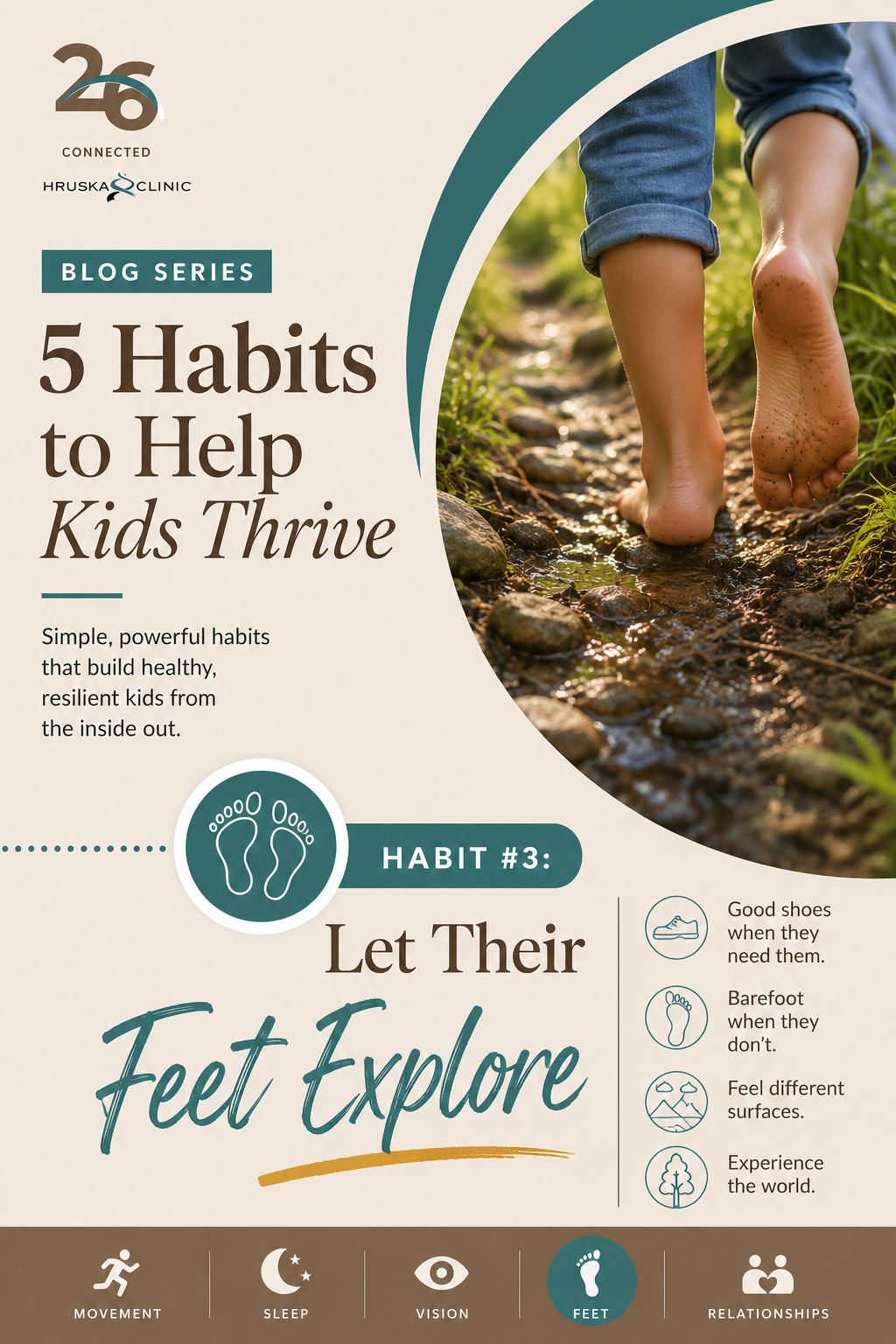
Habit #3: Let Their Feet Explore
Kids spend a lot of time on their feet.
Walking through school. Standing in the kitchen. Running errands. Playing sports. Walking across concrete, hardwood floors, sidewalks, and other hard, predictable surfaces.
And then we put shoes on them for much of the day.
Shoes are important. The right shoes can provide the support and stability children need when they are spending long periods of time on hard, flat surfaces.
But there is another side to healthy foot development that is easy to overlook:
Kids also need opportunities to experience the ground with their feet.
One simple habit we can encourage is to let their feet explore.
Feet need variety, too
Think about what happens when a child walks barefoot through the grass, over rocks, across sand, or around a playground.
The surface changes.
Their feet have to adapt.
Their ankles and legs have to respond.
They have to adjust their balance and change how they move.
Compare that with walking across a flat sidewalk or hard floor. The environment is much more predictable, and the demands on the foot are different.
Neither experience is “better.”
Kids need both.
We want to give growing feet opportunities to experience different surfaces, different challenges, and different ways of moving.
Shoes have a purpose
Going barefoot isn’t always the best answer.
When kids spend long periods walking or standing on hard, flat surfaces, an appropriate shoe can provide a helpful foundation. A good children’s shoe should allow the foot to function while providing the amount of structure and support appropriate for the activity.
This is especially important when shoes are being worn for hours at a time at school, during activities, or while walking on hard surfaces.
But shoes shouldn’t have to do all the work.
And some footwear isn’t particularly well suited to being a child’s primary shoe.
Crocs, slides, and other loose-fitting footwear can be convenient, but they aren’t necessarily the best choice for spending all day on hard surfaces or for activities that require the foot to work harder.
The goal isn’t to find the “perfect” shoe.
The goal is to match the shoe to the environment and the activity.
Let them go barefoot when the environment allows
When kids are playing outside in a safe environment, give them opportunities to take their shoes off.
These are the moments where feet can do something different—feel texture, adjust to uneven ground, and respond naturally to the environment.
And that matters.
Kids don’t need to be protected from every uneven surface. They need chances to experience them in a safe, playful way.
It doesn’t have to be complicated
Helping kids thrive isn’t about finding one shoe that they wear everywhere or making sure they’re barefoot all the time.
It’s about variety.
Give them good shoes when the environment calls for it. Let them go without when it doesn’t.
Let them feel different surfaces.
Let them move through different kinds of terrain.
Let their feet experience the world.
Maybe the habit is as simple as this:
Give your kids good shoes when they need them—and opportunities to go without them when they don’t.
Growing feet don’t just need protection.
They need experience.
Recent Comments