
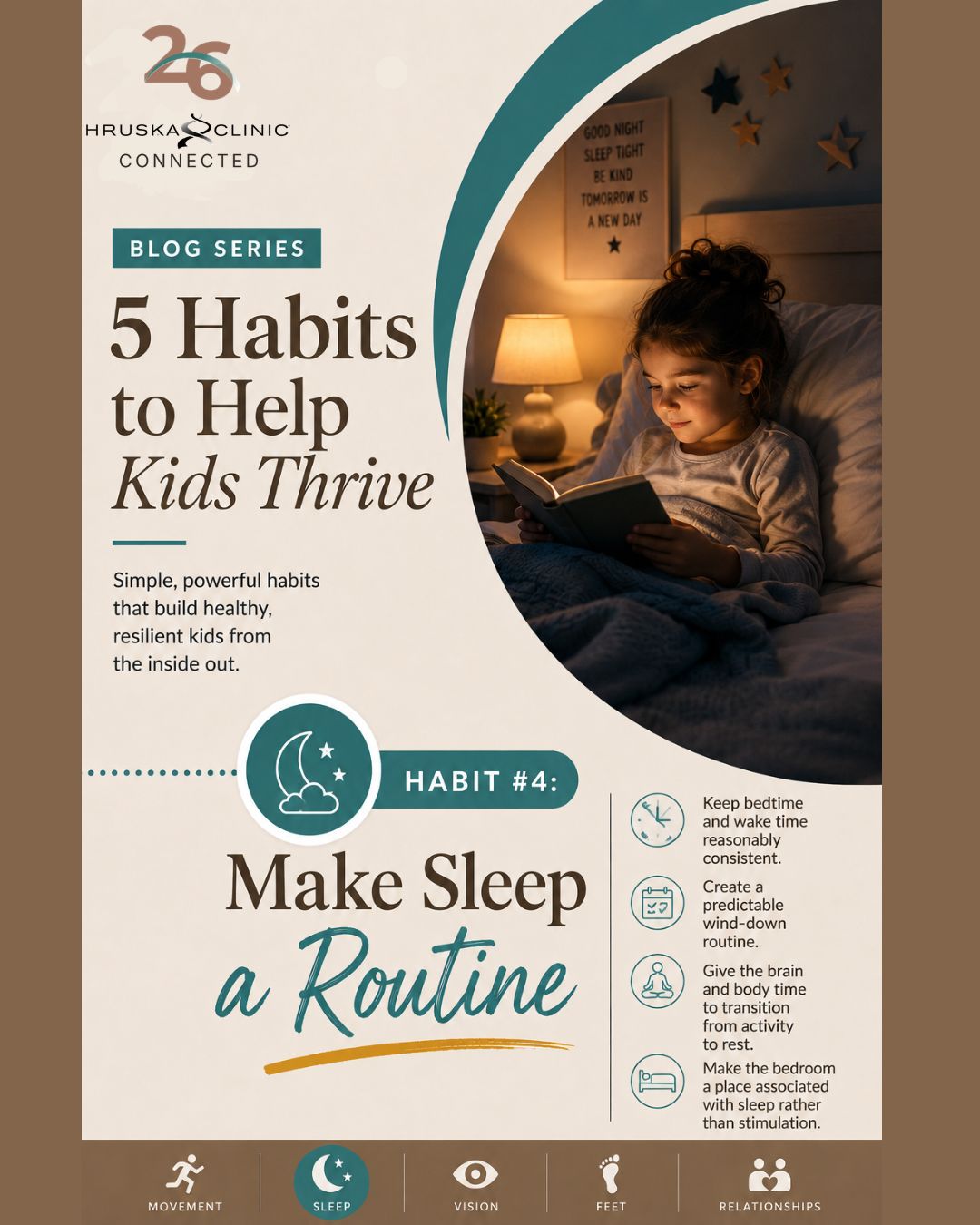
Habit #4: Make Sleep a Routine
Kids are busy.
School. Sports. Homework. Friends. Activities. Screens. Family life.
And sometimes sleep gets pushed to the bottom of the list.
But if we want kids to feel good, learn well, recover from the demands of the day, and keep growing and developing, sleep can’t just be whatever happens when everything else is finished.
Sleep needs to be a priority.
One simple habit we can encourage is to make sleep a routine.
Sleep needs consistency, too
There are plenty of sleep tips out there.
Get morning light. Turn off the screens. Keep the room cool. Avoid certain foods. Follow a bedtime routine.
Many of those things can be helpful.
But sometimes we can get so focused on finding the perfect sleep hack that we miss something much simpler:
Our bodies like rhythm.
Going to bed at roughly the same time and getting up at roughly the same time gives the body a predictable pattern to work with.
That doesn’t mean every night has to be perfect. Kids have late games, vacations, sleepovers, family events, and the occasional night when everything goes off the rails.
But when bedtime and wake time are constantly changing, sleep can become harder to manage.
A consistent routine gives kids a predictable signal:
This is when we slow down. This is when we sleep. This is when we wake up and start the day.
Make the bed a place for sleep
One of the simplest things parents can do is think about what the bed means to a child.
If the bed is where they do homework, play games, watch videos, and scroll through their phone, then getting into bed doesn’t necessarily mean it’s time to sleep.
Their brain has learned that the bed is a place for activity and entertainment.
Instead, when possible, give those activities another home.
Do homework at a desk or table. Play games somewhere else. Keep the phone out of bed.
Not because these things are inherently bad, but because the bed should have a clear purpose.
Your bed is where you go to sleep.
Give them a chance to decompress
There is another part of the sleep routine that can be easy to overlook.
Kids spend much of their day sitting, learning, performing, and being “on.” When they get home, it can be tempting to move immediately from school to homework to dinner to activities to shower to bed.
Sometimes kids need a little time to decompress.
Go outside. Move around. Play. Talk.
Do something that isn’t school or a screen.
Then come back to homework and the rest of the evening.
A little unstructured time can help create a better transition between the demands of the day and the need to wind down.
It doesn’t have to be complicated
Helping kids thrive isn’t about creating the perfect bedtime routine.
It’s about creating a predictable rhythm.
When possible, keep sleep and wake times consistent. Give the bed a clear purpose. And give kids some time to slow down at the end of the day.
Maybe the habit is as simple as this:
Make sleep predictable.
When the day is over, let the bed be a place where the body knows it’s time to rest and recover.
Sleep isn’t something we squeeze into the leftover hours of the day.
It’s part of how kids grow, learn, recover, and thrive.
Recent Comments